


System
Stats
Your characters abilities are tracked by the use of the eight major Attributes: Physical (Finesse, Might, Grit, Heart) and Mental (Savvy, Brilliance, Charm, and Daring).
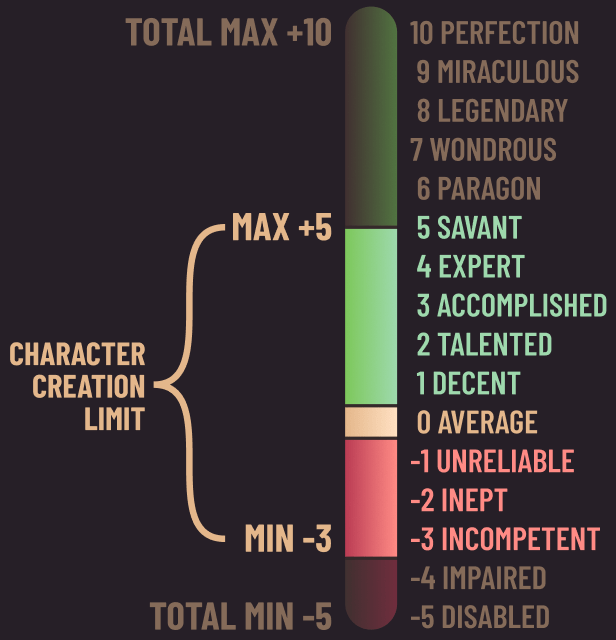
The more time you invest into one of the eight main Attributes, the more it will affect your performance in all the Skills it includes. This score is used to adjust rolls based on your your prowess (or weakness) in a certain Attribute. Essentially, the better you are at a thing, the higher your test bonus is; the worse you are at it, your dice rolls will be reduced. An absolutely average person, who is neither good nor bad in any one thing, would have a 0 in all eight attributes.
Base Attribute Score
When creating a character, your initial starting attributes will be determined by both your Species and your Culture. After that, you may alter them by way of  Experience Points (XP). The two primary ways of altering your Attributes with are through the use of Growth Features in Character Creation, and through Archetypes as you progress through the XP Web.
Within Character Creation, your Attributes are limited to a minimum of -3, and maximum of +5, but during a normal campaign, attributes can go as low as -5, and as high as +10.
To see more about each attribute and its associated skill, visit each Attribute page below:
PHYSICAL ATTRIBUTES
Finesse

Might

Grit

Heart

MENTAL ATTRIBUTES
Savvy

Brilliance

Charm

Daring

REFLEXES
You’re not always in control! Sometimes you will have to react to the world around you, be it with lightning speed, a clear mind, or a silver tongue. When you are being affected by an external force that would require you to react in kind, the GM will have you make a Reflex test. In order to determine how successful you are, this compares the action happening against your own stats. For example, if someone is attempting to throw a book at your tender and lovable face, the GM may ask you to roll a Finesse Reflex to avoid it.
For each level of ❱ training you have in a Reflex, you multiply the score modifier for that Reflex Roll by an additional 1.
1 ❱ training: Your Attribute Score ×1 (or no penalty if the Attribute Score is 0 or below)
2 ❱❱ trainings: Your Attribute Score ×2
3 ❱❱❱ trainings: Your Attribute Score ×3
and so on…

SKILL TRAINING
Within all of the Attributes are multiple Skills, which represent more specialized categories of abilities. Skills are the most common roll tests a player will do for their character.
Each level of skill ❱ training you gain will allow you to more consistently perform basic actions by granting small roll test bonuses. You will also potentially be able to perform more difficult actions that amateurs can not. The chart below shows the base level bonuses you get for every skill in the system. For more details about the unique abilities and bonuses, see each skill’s section underneath its corresponding attribute.
No training ⬧
UNTRAINED
You can perform only Untrained actions for this skill
1 training level ❱
NOVICE
+1 to skill tests
(stacking)
You can perform Novice actions
2 training levels ❱❱
INTERMEDIATE
+2 to skill tests
(stacking)
You can perform Intermediate actions
3 training levels ❱❱❱
EXPERT
+2 to skill tests
(stacking)
You can perform Expert actions
4+ training levels ❱❱❱⮞
SPECIALIST
Specialist Bonus
You gain a unique Specialization/Mastery Feature of your choice
Base Stats
Regardless of Attributes and Skills, all living creatures possess the following base stats for the purposes of the system.
Life Forces:
Energy Sources:
Physical Resources:
Mental Resources
LIFE FORCES
 Health Points
Health Points ( HP) are the measure of a creature’s total maximum physical life force. These points are a generalized combination of the state of the body in health, injury, and all physical ways.
If a creature loses all HP and  FP at the same time, it is dead. For a short time, a Soul may linger before passing on to the unknown beyond. During this window, some deep magics are known that may be used to re-bind the Soul to a living vessel, but the vessel must be in strong enough to support a Soul.
All creatures begin with a base of 5 HP, but they may increase this with features and/or experience.
 Heart Dice
This is a creature’s potential to heal living matter, whether within their own body or someone else’s. When resting, relaxing, restoring, or recovering, a creature will use their HRT Dice to determine how much they can recover.
All creatures begin with 1d4 HRT Die, but they may increase this with features and/or experience. Each improvement follows the Tier chart below.
Heart Die Tiers:
1d4
1-4 HP
🡺
1d6
1-6 HP
1d8
1-8 HP
1d10
1-10 HP
2d6
2-12 HP
2d8
2-16 HP
3d6
3-18 HP
3d8
3-24 HP
3d10
3-30 HP
4d8
4-32 HP
5d8
5-40 HP
5d10
5-50 HP
+1d10
∞
Note: When a features reads “Improve your HRT Die“, you will replace your current HRT Die with the new tier listed. For example, when improving from 1d4 to 1d6, you do not roll both 1d4+1d6, you simply use the new 1d6 instead. However, if you choose to improve your tier beyond 5d10, each subsequent improvement recurringly adds 1d10.
Dying
When reaching 0 HP, a creature will be put to a HRT test each round. Upon failure, the creature will lose 1 FP.
When taking damage at 0 HP, a creature will take Fatigue Damage.
If a creature loses all HP and FP at the same time, it dies.
 Soul Points
Soul Points ( SP) are the measure of a creature’s total maximum non-physical life force. These points are a generalized combination of mental health, sanity, and will to live, and are tracked together for situations where a creature may be inching closer to death, but their physical health is not affected.
If this is reduced to zero, the creature’s soul is immediately Lost. Some magic may be able to retrieve it, but only the most powerful spiritual forces can bring a Lost Soul back to the world of the living, and it must also be willing to return.
Soul Damage
When taking Soul Damage, a creature must succeed an  Tenacity test [10]. Upon failure, lose 1 SP, unless otherwise specified.
All creatures begin with 5 SP, but they may increase this with features and/or experience.
 Damage Resistance
For each ❱ training level in Damage Resistance, you reduce each instance of that damage type by 5. You also gain an additional +5 to any dice roll to avoid the effects of that damage type (i.e. slowed from frost).
There are 14 damage types, listed below.
Physical
CHOPPING

Using sharp weapons in concentrated bursts, intended to cleave, hack or sunder a target into pieces
POKING

Using thin instruments to pierce, bore, or impale a target. Often precisely aimed at weak spots
SHREDDING

Violent and often messy actions intended to rip, tear, or mangle a target
SLICING

Quick and clean attacks that cut, shave, or slash a target
SQUISHING

Blunt force caused by large objects that smash, clobber, or crush a target
Elemental
ACRID

Poisonous, acidic, toxic, and corrosive effects, typically effective against organic lifeforms
CHARGED

Shocking energies, booming sounds, and magnetic forces, typically effective against metallic or rigid targets
FRIGID

Numbing, slowing, chilling, and arctic freezing effects, typically effective against liquid targets
TORRID

Burning flames, boiling blisters, and scorching heat, typically effective against organic lifeforms
Magical
ARCANIC

Raw, primal magical energies that are gathered and focused upon a specific point
COSMIC

The majestic spirit forces of light and life, typically effective against spirits, undead, and targets with sensitive eyes
MYSTIC

The raw spirit forces of the mysterious and unknowable, typically effective against spirits, souls, and the superstitious
PSYCHIC

Neural effects, psionic torment, and mental damage, typically effective against weak minds
UMBRIC

The inevitable spirit forces of decay and death, typically effective against organic lifeforms with souls
ENERGY SOURCE
Fatigue Points
Fatigue Points ( FP) area creature’s total maximum physical energy. These are used to resist exhaustion and effects that wear a body out. Some creatures can also actively spend their Fatigue Points to perform talents and abilities.
All creatures begin with a base of 5 FP, but they may increase this with features and/or experience.
Fatigue Damage
When taking Fatigue Damage, a creature must succeed an  Endurance test [10]. Upon failure, lose 1 FP, unless otherwise specified.
Exhaustion/Dying
When reaching 0 FP, a creature will be Exhausted, and will not be able to use any  AP.
AP.
If a creature loses all HP and FP at the same time, it dies.
 Mana Points
Mana Points ( MP) are a creature’s total maximum non-physical energy and their potential to exert their will over it. The most common use for this is magic spells, but other talents and abilities may be able to call upon Mana to perform non-magical actions.
All creatures begin with 0 MP, but the creatures may be able to gain it with features and/or experience.
Mana Augmentation
Most Magic spells have a base MP cost, but they can be augmented to increase their potency. Some augmented spells will do more damage, some may increase the area or duration, and others may be more precise or specific. Each individual spell will offer information on how Mana Augmentation affects it.
PHYSICAL RESOURCES
Action Points
These represent a set amount of time for a creature to perform actions. Some actions may require multiple AP to perform.
 Movement Speed
Often simply abbreviated as “ Speed“, this is a creature’s total maximum movement distance when spending 1 AP to move. Most creatures’ Speed defaults to their movement on land.
Some creatures may have additional types of Speed, including swimming, flying, and more. These may reference the creature’s base Speed, but are independent sources of movement in many cases. For example, affecting a creature’s Flying Speed may not affect its base land Speed.
 Sight
Sight
Each creature begins with a base sight range of 100ft. Depending on the local light level and their biology, their range and color-vision may be adjusted.
OTHER RESOURCES
Experience Points
Experience Points ( XP) allow a person to level up one piece at a time, gaining stats, skills, magic, talents, and abilities, as well as archetypes and attribute points. Most XP is achieved through gameplay and can be spent using the XP Web. Each 1 XP is equivalent to one “pip” on the XP Web.
All Adventurer characters created in the system begin with a base of 28 starting XP. All pre-made Origins are designed to use 21 XP (15 pips in the Character Creation web, and 6 Skill ❱ training), so most characters will have an additional 7 XP to use for Growth Features or to claim additional pips in the XP Web.
 LP: Language Points
Language Points ( LP) are gained through features and/or experience, and can be spent to earn ❱ training levels in languages. The cost of each ❱ training level is based on the languages a person knows at the end of Character Creation. Languages that have less in common with a person’s starting languages may cost more LP to learn.
 Reputation
Reputation increases a person’s connection to Global Factions within the world. These Global Factions are fairly baseline ideologies that help to categorize people by lifestyle and values, and exist in almost every society around the continent. While these operate similar to the other Points systems, they are also fairly similar to ❱ training levels, but on a greater scale. Each Rep Point someone earns with a Global Faction may benefit them when interacting with people in that Global Faction, but may also impact them negatively when interacting with opposed Global Factions. Each person and group likely belongs to one or more Global Factions based on their own values. Many Origins will grant bonuses to a person’s Reputation in appropriate Global Factions.
Some examples of these Global Factions include “Blade Earners” for those who follow a militant path, or “Greenleaves”, for those who value naturalist beliefs.
 Daring Dice
A creature with Daring Dice may use each die once per rest to re-roll any d10 that they rolled. The new result must be used. If the new result is worse than the original roll, it is considered a ▼Collapse. By default, Daring Dice may only be used for the creature who owns them, but there are some features and talents that allow a Daring Die to be bestowed upon an ally.
 The Beanut Lands