

Lovalian
Biology
Stature and Build
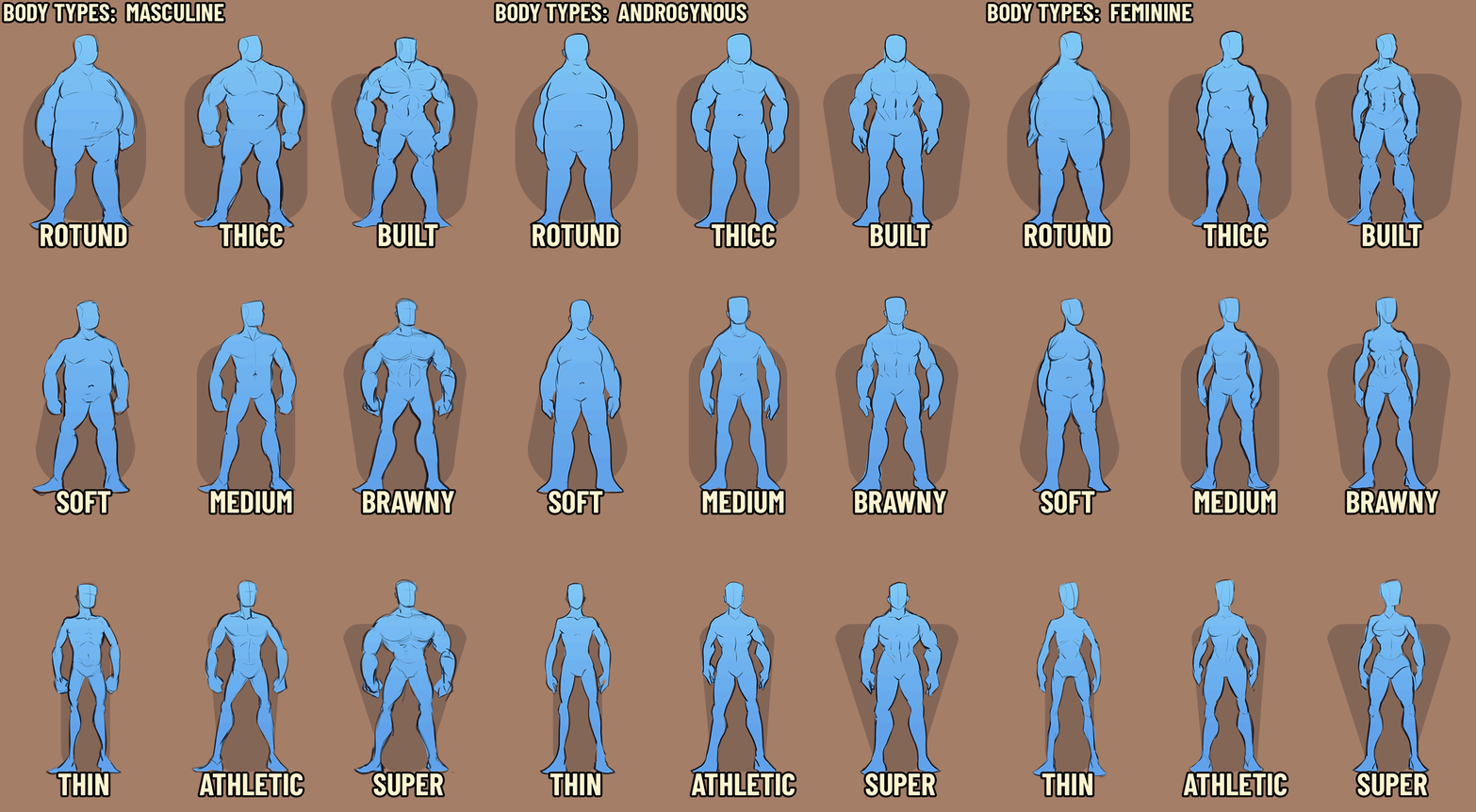
Mostly thanks to their historically generous society and varied ecosystems in the north, the Lovalians’ bodies are fairly diverse. Each individual has the potential to reach the extremes of any body type, but it is very unlikely that a Lovalian’s body type will change drastically after they are fully grown, due to their Tok heritage.
Familial genetics and heritage play a large part in any individual Lovalian’s body type, so Lovalians who live in similar regions or have similar lifestyles often resemble each other.
Most Lovalians are between 7’6″ and 8’6″ tall (~230 – 260cm)
Skeletal System
Lovalian frames have evolved to be much lighter than their other Tok relatives. Though scientific evidence should prove their unbelievably-light skeletons to be brittle, they are unusually resilient for how weightless they are. A Lovalian who stands around 8ft. tall weighs about the same as a comparable Willonian who is about 6ft.
Skin & Complexion
Lovalian skin still retains its Tok resistance to difficult environments, though for them it is particularly effective in high winds and cold temperatures. Due to a historic lack of sun exposure, and a dire need to bundle up in layers of clothing, Lovalian complexions have lost a great deal of the otherwise bold Tok characteristics, both in hue and depth. They have become very desaturated, and in some cases even resemble the snow-covered rocks and cliffs of their homeland.
Lighter (right)
colder and high-altitude environments
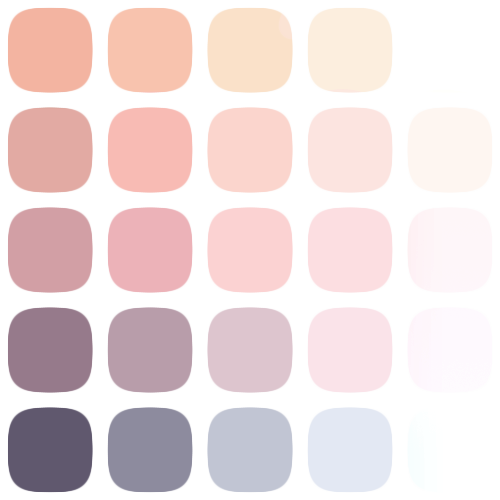
Wheat
urban and non-native areas
Dawn
urban and non-native areas
Rosy
urban and non-native areas
Dusk
rural and isolated areas
Slate
rural and isolated areas
Darker (left)
warmer and lower-altitude environments.
Hair
Lovalian hair colors follow the same color chart as above, most commonly leaning toward the lighter half. It is never naturally darker than a light brown, but some urban Lovalians like to dye their hair, as their lighter tones take to dyes very well.
Lovalians retain the hair density of their Tok ancestors, but the strands have evolved to be incredibly soft and wispy. Lovalian hair grows quickly and must be groomed fairly often.
Eyes
Many Lovalians have retained the mono-eyelids of their Tok ancestry, namely those who have thrived in the central, populated areas of the Frostlands. They commonly have a prominent forehead or strong browline.
Lovalians usually have light-colored eyes. The most common colors include Grey, Blue, Olive, Hazel, Honey, and Lavender. Less common colors include Pink, Deep Blue, Violet, Gold, and Green. Lovalians of mixed heritage may have darker eyes.
Ears
Lovalians are the only Tok people without distinctly pointed ears. It seems that evolution did not favor the extra skin, and so their ears have become more downturned, almost square. The top curve of the ear is practically folded over on itself, providing insulation to the outer ear where it is not connected to the head.
Teeth
Lovalian teeth are particularly resilient, and rarely struggle with foods that a real-life human would shudder to consider crunching. While this offers no particular advantage, it is worth noting that some more uniquely Lovalian foods are not suited for regular people.
Reproduction
The Beanut Lands does not have half-species for mechanical clarity, but it is possible for some inter-species relations to produce offspring. A person with mixed-species parentage may exhibit physical traits from a parent of another species. If you are interested in this level of customization for your image and story, please be sure to examine the Heritage subgroups to determine which groups your parents come from. You may also use Growth Features during character creation to adjust your mechanics to fit your narrative decisions if you are inclined.
Lovalians can procreate through traditional 2-partner reproduction with any other Tok species. This includes Torgali, Canzians, and Dawi. They are unable to produce children with sylvan or varian people, and will not exemplify unique traits from those species, unless otherwise noted in a Heritage subgroup.
For inter-species parentage, the following biological rules will always apply:
Lovalian + Lovalian: a child will always be Lovalian, taking the male parent’s heritage
Lovalian +Torgali: a child will be the same species as their female parent
Lovalian + Canzian: a child will be the same species as their female parent
Lovalian+ Dawi: a child will be the same species as their male parent
 The Beanut Lands